The Engine Inside
Six core technology pillars enable MineX to operate autonomously in GPS-denied, communication-challenged underground mine environments.
Edge AI Processing
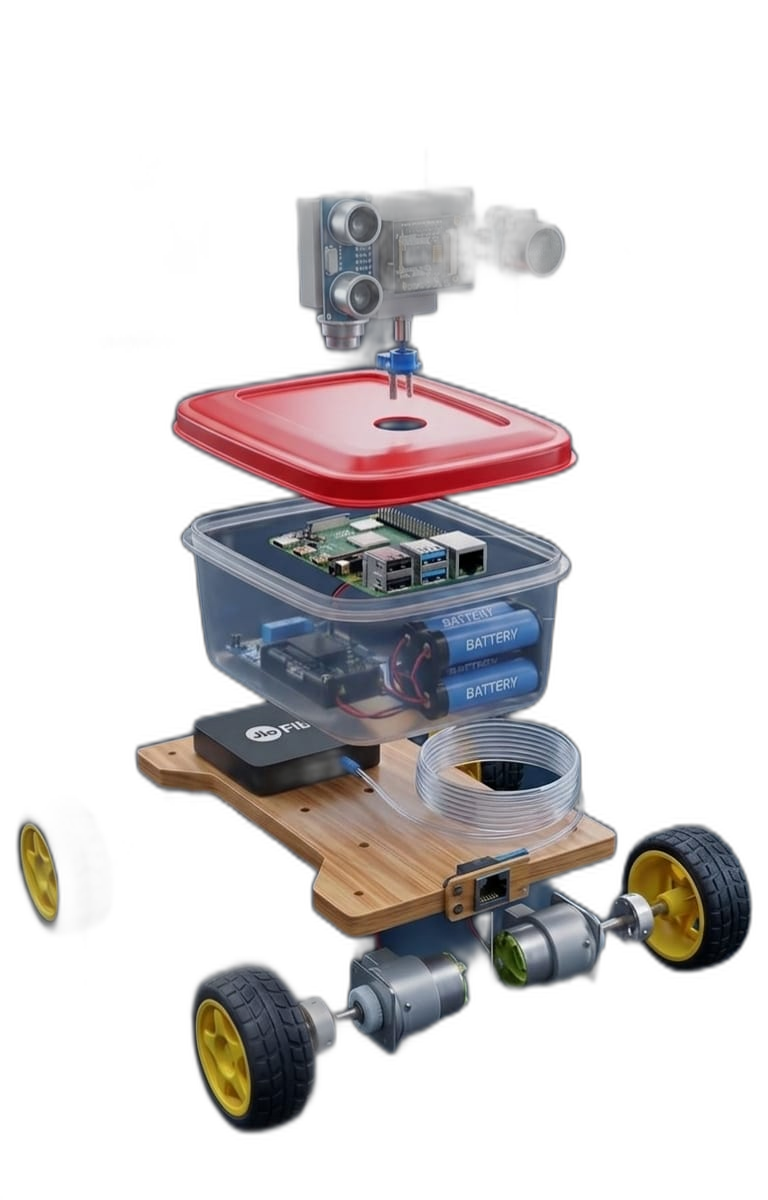
MineX runs all critical AI inference, SLAM computation, sensor fusion, and decision-making locally on an NVIDIA Jetson or Raspberry Pi 4. Edge processing ensures low-latency responses and full operational continuity even without surface connectivity.
Computer Vision
YOLOv8 with TensorRT quantization runs on-device, processing frames from both the FLIR Lepton 3.5 thermal camera and Arducam 8MP NOIR night vision camera. Thermal imaging detects human heat signatures while NOIR provides visual context in zero-light conditions.
3D SLAM & Navigation
A 2D RPI LiDAR and MPU-9250 (9-DOF IMU) feed into a Pose Graph SLAM pipeline via the ROS2 Nav2 stack. This enables real-time 3D reconstruction of multi-level mine tunnels, autonomous path planning, and obstacle avoidance — all without GPS.
Underground Communication
IEEE 802.11ah Wi-Fi HaLow (Heltec modules) creates a self-healing mesh network with strategically placed relay nodes. This provides long-range, low-power communication underground. WebRTC enables two-way voice between surface operators and subsurface.
Multi-Gas Hazard Detection
Four dedicated industrial MEMS gas sensors continuously monitor methane (CH₄), carbon monoxide (CO), hydrogen sulfide (H₂S), and ozone (O₃). Gas concentration data is mapped onto the 3D SLAM model for visual hazard zone classification.
Fault Tolerance & Autonomy
Each subsystem runs as an independently supervised thread with automatic fault isolation and restart. When communication is lost, the rover retraces its SLAM path to the last known relay node. Smart docking stations enable autonomous recharging and data transfer.